

IK codes
By: Calum Mansell IEng MIET
When selecting enclosures, the designer of an electrical installation must consider all external influences the enclosure will likely encounter throughout its design life. This includes mechanical impact which can damage the enclosure and ultimately compromise the safety of the installation. Fortunately, there is a standardized method, known as the IK rating system, to measure an enclosure’s resistance to mechanical impact. Once the level of resistance to mechanical impact is determined, the enclosure is assigned an IK code.
What are IK codes?
IK codes are used by electrical designers when selecting enclosures for specific environments, such as those that are exposed to harsh conditions, vandalism, and accidental damage. Prevention of this damage is essential to avoid a risk of exposed live parts being accessible, impaired IP ratings, and loss of equipment functionality, such as lighting in a public space, as well as the financial implications of regular repair or replacement of the damaged enclosure.
Simply put, IK codes are used to indicate the degree of protection provided by an enclosure against external mechanical impacts and differ from IP codes, which are for ingress protection. They are not a new concept as IK codes were first referenced in the withdrawn standard BS EN 50102:19951 and are now contained within BS EN 62262: 2002+A1:20212. This standard classifies the degrees of protection provided by enclosures against external mechanical impacts.
IK codes are broken down into two parts: ‘IK’, which stands for impact protection, and a number from ‘00 to 11’, which indicates the degree of protection provided by the enclosure against mechanical impact. (See Figure 1.)
Figure 1: IK codes example

IK codes and IP codes
The IK ratings system certifies the enclosure can endure levels of impact, vandalism, or heavy vibrations, although it does not account for the ingress of solid foreign bodies or water ingress provided by the IP ratings system. Additionally, some external enclosures or those used for heavy industrial environments could also require special consideration regarding the material, coating, and sealing required, to mitigate the effects of corrosion and ultraviolet (UV) rays.
While IK codes and IP codes are based upon separate ratings systems, it is important to consider both codes when selecting an enclosure. For example, an enclosure that is deemed highly weather-resistant and capable of withstanding heavy rain, such as IPX6, but which does not have a high IK code, leaves the enclosure susceptible to damage upon impact. Equally, an enclosure rated as IK10 confirms robustness in the event of impact. However, without a sufficient IP code, it could be prone to water ingress.
As mentioned above, IK codes can be found within BS EN 62262, whereas IP codes are referenced within BS EN 60529:1992+A2:20133, following the same two-part format as the IK code, e.g. IP66. However, prior to the creation of the IK rating system, on occasion a third digit (now obsolete) was added to the IP code to signify the level of mechanical impact protection, e.g. IP66(9).
How are IK codes assigned?
The IK rating system is shown in Table 1, with IK00 indicating that no protection against mechanical impact is provided, while IK11 offers the highest level of mechanical impact protection. It is important to note that some manufacturers provide higher codes for extreme environments that are not defined in BS EN 62262.
Table 1: IK codes and impact energy (information based on Table 1 of BS EN 62262)
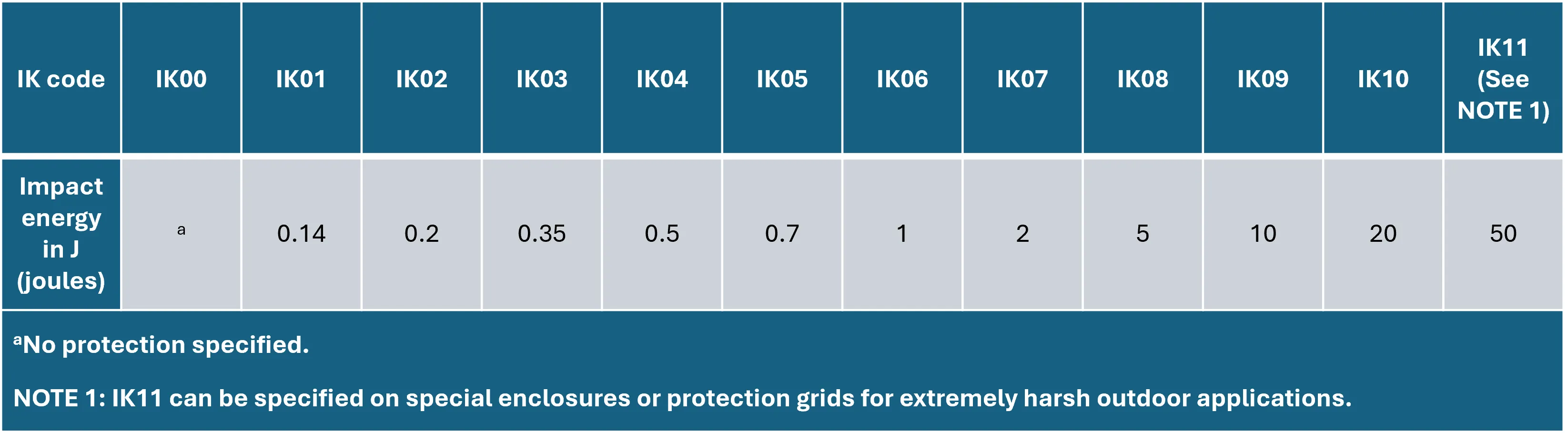
Impact energy is measured in ‘joules’ to quantify the amount of kinetic energy an enclosure can withstand from impact. This measurement takes account of the weight of the object striking the enclosure known as the ‘mass’ and the height it was dropped from.
Enclosure testing
Enclosures are provided with an IK code following a series of tests to verify the enclosure’s ability to withstand impact. While manufacturers are permitted a level of discretion over the testing procedure, BS EN 62262 specifies the general requirements for these tests, which include:
- Atmospheric conditions.
- The number of samples to be tested.
- The conditions for mounting, assembling, and positioning the samples (to replicate likely service conditions).
- The number of impacts and points of application.
- Whether the enclosure is tested with moving parts in motion.
- Whether the enclosure is energized for testing.
Additionally, the standard identifies the test equipment (different types of hammers, e.g. pendulum, spring, and vertical) to be used to produce the energy levels required. Energy levels are increased until the enclosure fails the test, or the maximum impact level is achieved. A standardized process is adopted for hammer tests and further details on hammer testing can be found in BS EN 60068-2-75:2014+A1:2025: Environmental testing. Tests. Test Eh: Hammer tests4.
An enclosure may be assigned more than one IK code, and it is important to confirm what parts of the enclosure have been verified, with consideration to the hinges, locks, fixings and brackets, cable entries, and doors of the enclosure, etc. The differences in IK codes are due to the level of impact a specific part of an enclosure can withstand, and these variances are often based upon the angle, or which side of the enclosure is impacted.
Therefore, those specifying an enclosure may find that an enclosure has an overall IK code assigned along with a different code, where, for example, a lower code is issued for a specific part of the enclosure that is not as robust. In scenarios such as this, it is common for manufacturers to list these separately in product specifications.
Design considerations
The Requirements for Electrical Installations, IET Wiring Regulations, BS 7671:2018+A4:20265 (referred to as BS 7671 from hereon in) refer to IK codes within the standard although, unlike IP codes, they are not described within Appendix 5. However, Appendix 5 details different levels of severity in respect to impact ‘low’, ‘medium’ and ‘high’, under the ‘AG’ code.
Specific reference to IK codes for equipment can be found in several places in Part 7 of BS 7671, which covers special installations or locations, i.e. solar photovoltaic (PV), caravan and camping parks, marinas, outdoor lighting, and electric vehicle charging installations. (See Table 2.) While Regulations 705.522.16 and 740.521 (b), respectively, refer to 5 J, the equivalent of IK08 for wiring systems.
Table 2: BS 7671 references to IK codes

Figure 2: IK07 example

Figure 3: IK08 example
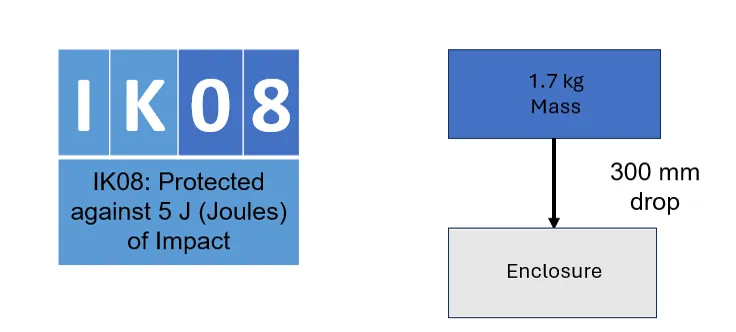
IK07 is generally considered to provide a moderate level of impact protection. Although IK08 offers a more robust solution than IK07, providing over double the impact resistance. IK08 is commonly used where an enclosure may encounter frequent or more severe impacts. It is important to note that all the special installations or locations in BS 7671 that refer to IK codes also contain minimum IP codes. For example, Regulation 714.512.2.105 requires that electrical equipment shall have, by construction or by installation, a degree of protection of at least IP33 to protect against sprays.
Chapter 57, introduced in Amendment 4 of BS 7671, concerns stationary secondary batteries and although IK codes are not stated in the chapter, reference is made to the publicly available specification (PAS) 63100:20246, which contains IK codes:
- IK08 for power conversion equipment, such as inverters installed within garages, near driveways or parking spaces, and public highways (see Table 5, of PAS 63100:2024).
- Storage batteries installed in outdoor areas or wall-mounted at lower heights shall have a minimum degree of protection against external mechanical impact of IK10 (see Figure 4).
Figure 4: IK10 example
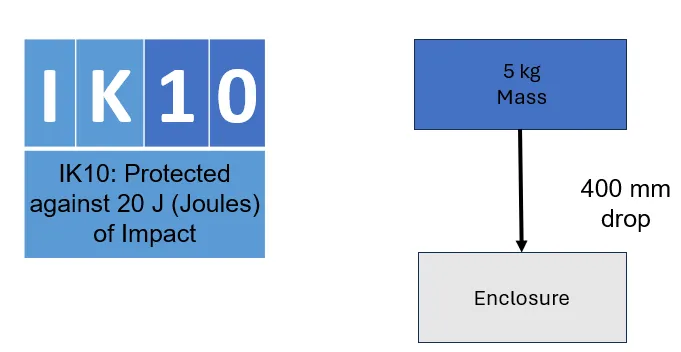
The importance of impact protection for batteries cannot be understated as any physical impact could pierce a cell, leading to thermal runaway, fires, or explosions. Batteries that are installed near driveways or garages are susceptible to damage from collisions with vehicles and while IK10 is a robust solution, it does not make the enclosure immune from damage in the event of vehicular collision. That is why additional measures such as bollards, plinths, or kerbs are necessary to reduce the risk of impact from vehicles at slow speeds. Similarly, increased IK ratings for enclosures are often specified in areas susceptible to vandalism, such as those open to the public. However, determined vandals may adopt repeated strikes and force entry via tools to circumnavigate the enclosure’s minimum impact resistance, so designers may need to consider enhanced security measures such as access control, concealed hinges, etc.
Ongoing inspection of an enclosure despite its IK code is an essential part of any preventative maintenance programme, to identify any signs of impact, general wear and tear, or simply verifying the enclosure is securely mounted to prevent damage.
Summary
As well as being a requirement of various British standards, appropriately selected IK codes reduce maintenance and replacement costs, prevent electrical hazards, and assist in maintaining equipment operation in harsh environmental conditions.
Careful selection of the desired IK code is important, as higher IK ratings often result in increased cost, greater weight, and a more difficult installation. Conversely, it should be remembered that selection of an IK code too low for the installation will ultimately increase costs for replacement, downtime, and reinstallation.
Acknowledgements
- BEAMA
- Joe Cannon
- Michael Peace
Further reading
- IET Guidance Note 1: Selection & Erection, 10th Edition
- IET Guidance Note 7: Special Locations, 8th Edition
References
(1.) BS EN 50102:1995 Degrees of protection provided by enclosures for electrical equipment against external impacts (IK code)
(2.) BS EN 62262:2002+A1:2021 Degrees of protection provided by enclosures for electrical equipment against external mechanical impacts (IK code)
(3.) BS EN 60529:1992+A2:2013 Degrees of protection provided by enclosures (IP Code)
(4.) BS EN 60068-2-75:2014+A1:2025 Environmental testing - Tests. Test Eh: Hammer tests
(5.) BS 7671:2018+A4:2026 Requirements for Electrical Installations, IET Wiring Regulations, Eighteenth Edition
(6.) PAS 63100:2024 Electrical installations. Protection against fire of battery energy storage systems for use in dwellings. Specification